
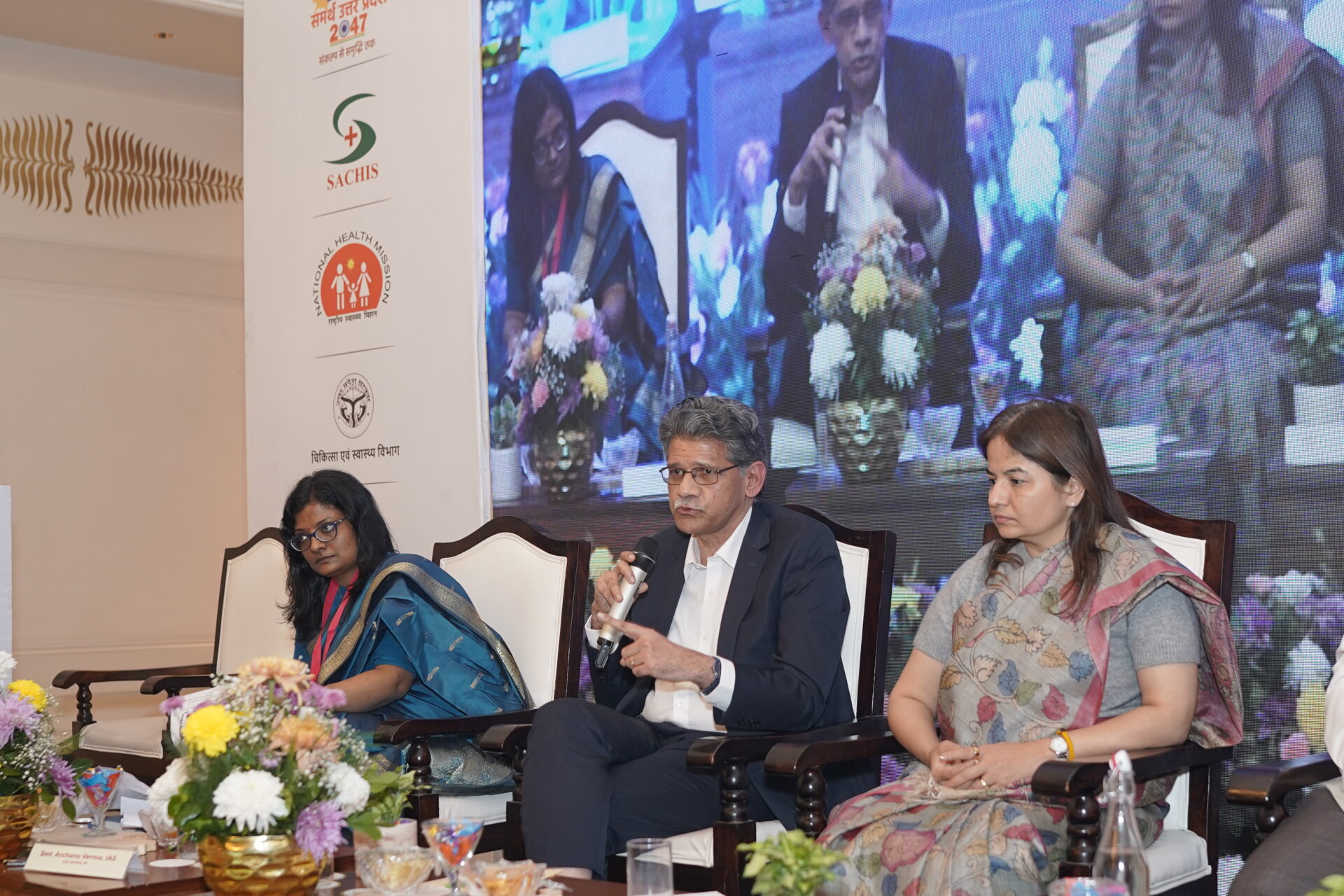
“Healthcare should reach our villages.”
At a session on Universal Health Coverage (UHC) and Quality of Care at the Stakeholder Consultation on Health and Medical Education Roadmap for Viksit UP@2047, Dr. N. Krishna Reddy, the CEO of ACCESS Health, underlined the need for quality healthcare services at all levels to achieve UHC.
The closed-door Stakeholder Consultation, held on December 1, 2025, in Lucknow, India, to create a citizen-centric blueprint for healthcare in the state of Uttar Pradesh at a policy level, is pivotal in bringing together some of the best minds in the country to bolster the state’s growth through health reforms.
The session on UHC, moderated by Ms Archana Varma, CEO, State Agency for Comprehensive Health and Integrated Services (SACHIS), featured a diverse panel, including Ms Jyoti Yadav, Joint Secretary and Additional CEO, National Health Authority (NHA), Dr Major Mukund Kulkarni, Chief Business Officer, Life and Health Insurance, Insurance Information Bureau of India (IIBI), and Dr Shankar Prinja, Professor, PGIMER Chandigarh and former Executive Director, NHA and Dr. Reddy.
The panellists delved deep into the nuances of government-funded schemes like Ayushman Pradhan Mantri Jan Arogya Yojana (PM-JAY) through the course of the conversation, touching upon issues of beneficiary base expansion, curbing fraud and abuse, long-term financial sustainability of the scheme in the face of universalisation, and access to timely and quality care to all citizens regardless of their ailment and location.
Ensuring Continuum of Care for Achieving UHC
Advocating for creating pathways for “life course continuum of care”, Dr Reddy shared his insights on closing the loop of getting patients back to the primary level of healthcare after being referred and discharged from tertiary care providers. Stressing the need for Standard Treatment Guidelines (STGs), a sentiment echoed by the panellists, he highlighted how monitoring adherence to these protocols can help the state evaluate policy actions and their effect on better health outcomes.
The panel also urged moving towards value-based care, moving away from the current volume-based approach to ensure quality services for citizens. Citizens need “access to care which is timely, decent quality, equitable, and provided with dignity.” Dr. Reddy reiterated this as an essential foundation for achieving UHC in Uttar Pradesh and India, also stating, “The public system provides free care, yet people seek private healthcare because they don’t trust the quality. But they also don’t trust the ethics of private healthcare providers. The government needs to have oversight on this.”
Many Pathways, One Destination
Incentivising value-based pricing for hospitals and leveraging AI-driven data analysis to curb fraud emerged as key strategies for PM-JAY’s sustainability—the first step towards UHC in the state. While Ms. Yadav called for building a unique citizen database to expand coverage and eliminate exclusion fears, Dr Prinja advocated for district-level metrics for avoidable hospitalisations to strengthen primary care.
Dr Reddy pushed for co-designing the models for UHC, involving providers, payers, and patients to reach a stage of co-governance. As the discussion came to a close, Ms Yadav, on behalf of NHA, called for steady progress towards universalisation of equitable healthcare and Vikshit UP in 2047.
***
ACCESS Health International has been a technical partner to SACHIS—the implementing agency for Ayushman PM-JAY in Uttar Pradesh—since the scheme’s inception in 2018.