
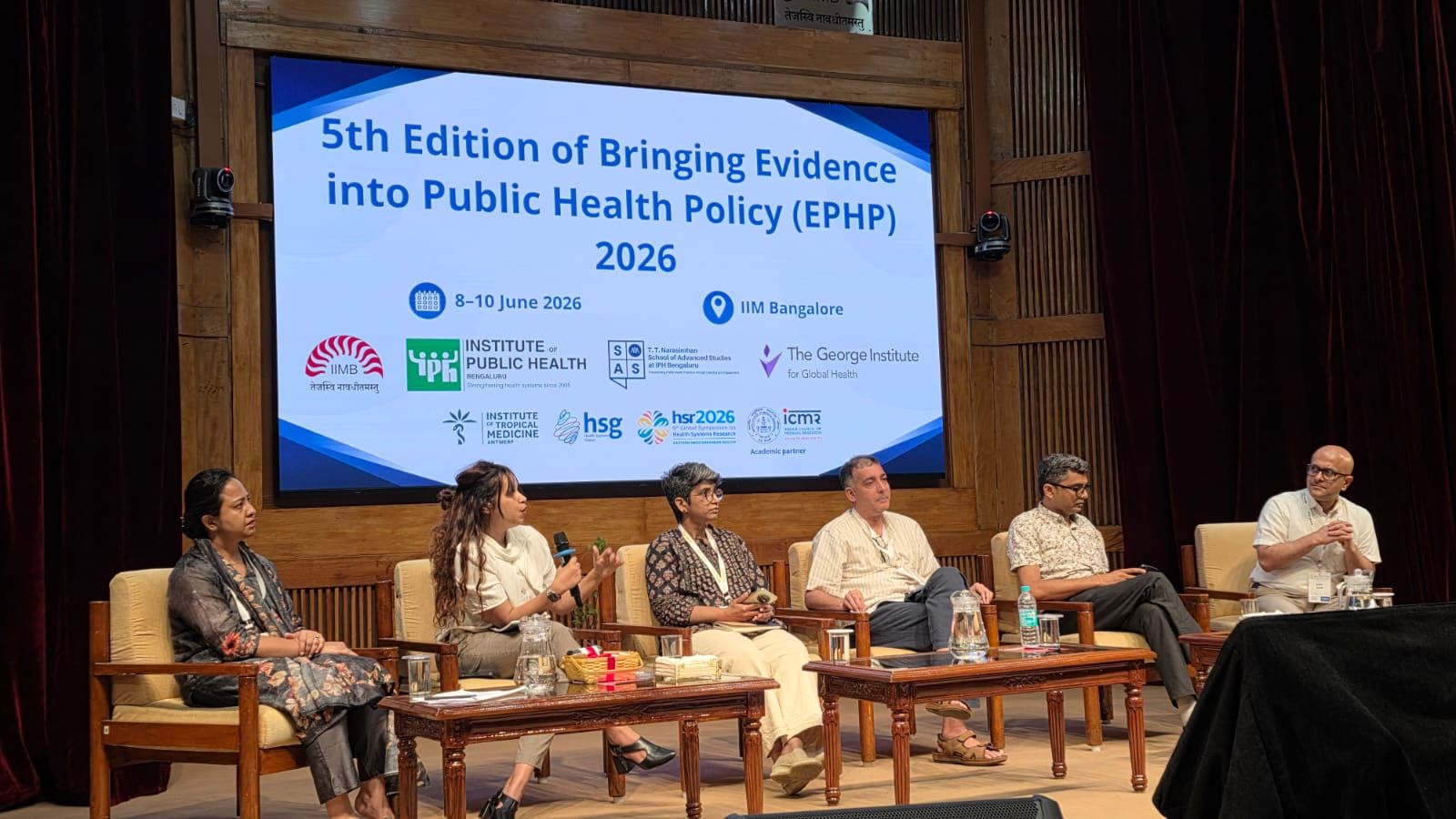
ACCESS Health International participated in the 2026 Emerging Perspectives in Health Policy (EPHP) Conference, held at the Indian Institute of Management Bangalore. The conference brought together researchers, policymakers, practitioners, and students to examine emerging challenges and opportunities shaping the future of health systems.
The event provided a platform for interdisciplinary dialogue on health policy, healthcare delivery, technology, and system transformation in rapidly evolving contexts. ACCESS Health contributed to these discussions through two research presentations focused on primary healthcare financing and the growing role of artificial intelligence in India’s healthcare ecosystem.
Maulik Chokshi, Global Director, Health Systems Research and Policy, presented the paper, Delivering Comprehensive Primary Health Care through an Integrated Public–Private Model: A Normative Policy-Oriented Costing and Pooling Analysis from India, co-authored with Oshia Garg, Research Associate, and Rajeev Prasad, Technical Specialist (Public Financial Management). The study examined the feasibility of delivering a comprehensive package of primary healthcare services through an integrated public–private model while remaining within India’s existing levels of health expenditure. The findings contribute to ongoing discussions on sustainable financing mechanisms and the role of mixed-provider models in strengthening primary healthcare delivery.
Sukriti Nagpal, Digital Health Analyst, presented the poster, Understanding Artificial Intelligence in India’s Healthcare Ecosystem, co-authored with Maulik Chokshi. The research mapped the rapidly evolving artificial intelligence landscape in Indian healthcare, identifying key policy initiatives, institutional actors, technology developers, healthcare providers, academic institutions, and development partners shaping the field. The work highlights the importance of governance, collaboration, and evidence generation as AI adoption continues to expand across the health sector.
Together, these contributions reflect ACCESS Health’s continued commitment to generating evidence and supporting dialogue on health systems strengthening, innovation, and policy. The conference offered valuable opportunities for knowledge exchange and engagement with researchers and practitioners working to address complex health challenges in India and beyond.
ACCESS Health extends its appreciation to the conference organizers, presenters, and participants for creating a valuable forum for collaboration and learning.