
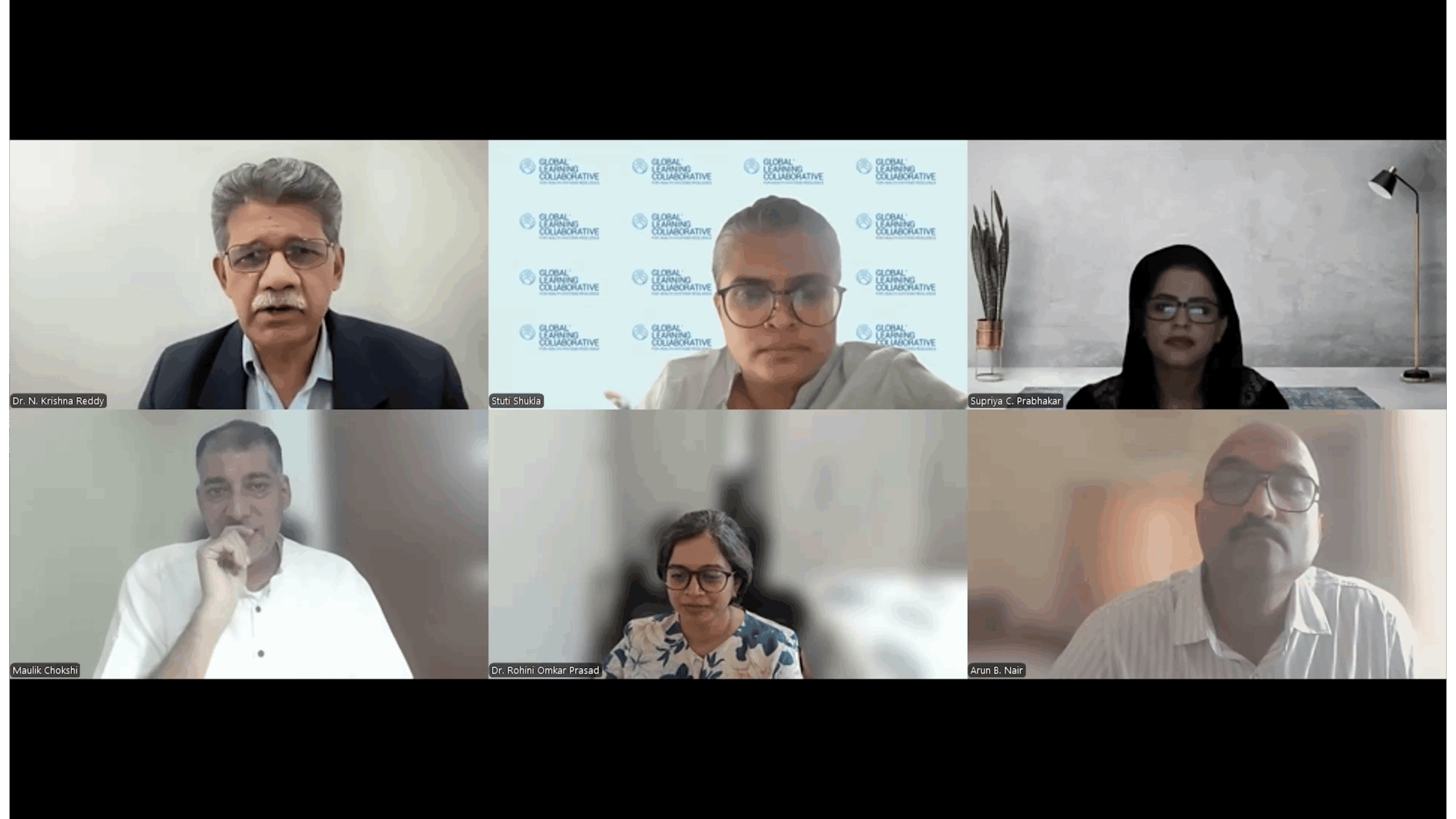
The Global Learning Collaborative for Health Systems Resilience (GLC4HSR), hosted by ACCESS Health International, launched its new monthly webinar series, The Journey to Resilience, with an inaugural session focused on Strengthening Health Governance Through Robust Monitoring and Assessment Systems. Bringing together experts from ACCESS Health International, the webinar explored how stronger assessment, monitoring, surveillance, and digital technologies can help governments make more informed decisions and build resilient, people-centred health systems.
Opening the session, Dr. N. Krishna Reddy, CEO of ACCESS Health International, emphasized that governance is fundamentally about informed decision-making. Effective health governance begins with understanding population health needs, monitoring health system performance, and maintaining surveillance systems that enable timely responses to emerging risks. While many countries have established data collection systems, he noted that the real challenge lies in translating information into evidence-informed policy and action.
Building Health Intelligence Beyond Data
Maulik Chokshi, Global Director, Health Systems Research and Policy, ACCESS Health International, highlighted that modern health systems are increasingly data-rich but often intelligence-poor. Drawing on India’s experience, he demonstrated that health outcomes depend not only on healthcare services but also on financing, education, social protection, environmental conditions, and other determinants that span multiple ministries.
He emphasized that while substantial data exists through national surveys, health information systems, disease surveillance platforms, and financial databases, significant challenges remain. Data often exists in silos, private sector information is limited, reporting cycles are infrequent, and systems lack interoperability. Strengthening governance, therefore, requires integrating these diverse data sources into a unified intelligence system that enables timely, evidence-based policymaking.
Bringing Decision-Making Closer to Communities
Presenting Kerala’s experience, Arun B. Nair, State Director, Kerala, ACCESS Health International, demonstrated how decentralised governance strengthens health system responsiveness. In Kerala, local self-governments play an active role in health planning, supervision, financing, and monitoring alongside the health department.
This model enables communities to identify vulnerable populations, coordinate across sectors, and respond rapidly to both routine health needs and public health emergencies. Examples included integrated management of non-communicable diseases, community-based palliative care, and district pandemic preparedness planning. The presentation highlighted that resilience depends not only on data availability but also on empowering local institutions to use information for timely action.
Learning from Singapore’s Evolution
Providing an international perspective, Dr. Rohini Omkar Prasad, Regional Director, Southeast Asia, ACCESS Health International, examined Singapore’s decades-long journey in building a responsive health system.
She illustrated how Singapore’s assessment and monitoring systems have continually evolved alongside changing population needs, from communicable disease control to chronic disease management and healthy ageing. Rather than measuring performance through static indicators, Singapore has progressively adapted its governance systems, financing mechanisms, and health intelligence to respond to emerging challenges.
A key lesson was the country’s transition toward population-based accountability, where integrated health clusters are responsible not only for delivering healthcare services but also for improving the health outcomes of the populations they serve.
Digital Technology as an Enabler of Better Governance
Supria C. Prabhakar, Technical Head – Digital Health Technology Applications and Services, ACCESS Health International, explored how digital technologies can transform assessment, monitoring, and surveillance.
She argued that today’s challenge is no longer collecting more data, but converting existing data into actionable health intelligence. Digital technologies can enable continuous population assessment, near real-time monitoring, and earlier detection of public health threats. However, these capabilities depend on robust health data governance, interoperability, high-quality data, and institutional capacity to act on insights.
Using examples from countries including India, Thailand, Brazil, and the United Kingdom, she demonstrated that digital infrastructure alone does not improve governance. Lasting impact comes when trusted data, strong institutions, and effective decision-making mechanisms work together to improve population health outcomes.
Looking Ahead
The discussions reinforced that resilient health systems require more than robust information systems; they require governance mechanisms capable of translating data into timely decisions and coordinated action. Across diverse contexts, from India and Kerala to Singapore and other global examples, the session highlighted a common principle: better governance depends on transforming information into intelligence that informs policy, planning, and implementation.
This inaugural webinar marked the beginning of The Journey to Resilience, GLC4HSR’s new monthly learning series designed to facilitate cross-country exchange, practical learning, and collaborative dialogue on priority health systems resilience themes. Future sessions will continue exploring key dimensions of resilient health systems through experiences from policymakers, practitioners, and researchers across regions.