
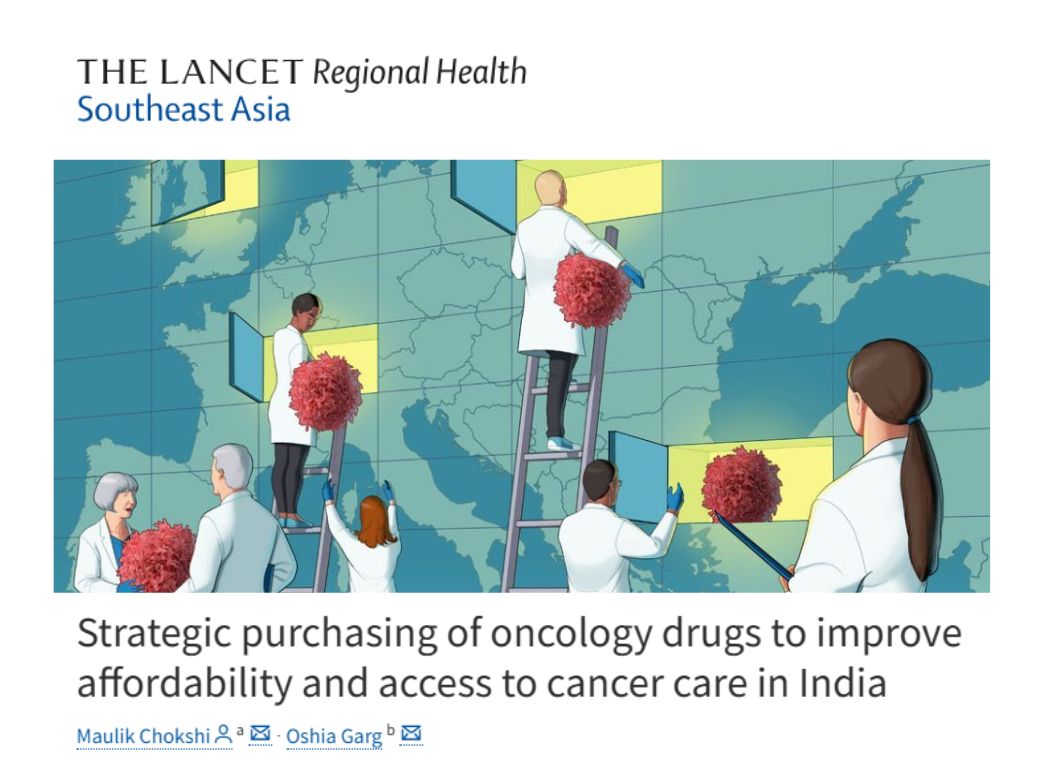
Cancer care in India is increasingly shaped not only by clinical innovation, but by the question of who can afford treatment, and at what cost. In a new Personal View published in The Lancet Regional Health – Southeast Asia, ACCESS Health colleagues Maulik Chokshi and Oshia Garg examine one of the most consequential drivers of financial hardship for patients: the price of cancer medicines. Read the full article here.
Despite advances in public financing and insurance coverage, medicines continue to account for more than 60% of out-of-pocket spending on cancer care in India, exposing households to severe financial risk. The article argues that this is not an inevitable outcome, but a policy choice – one that can be addressed through smarter purchasing decisions by health systems.
Authored by Maulik Chokshi, Global Director – Health Systems Research and Policy, and Oshia Garg, Research Associate at ACCESS Health, the analysis calls for a shift from fragmented, price-taking approaches toward strategic purchasing of oncology medicines. Drawing on evidence from India and global health programmes, the authors explore how pooled procurement and value-based pricing can work together to improve affordability while preserving incentives for meaningful innovation.
The paper is part of a broader body of research on cancer financing and access, supported by the Global Oncology Policy Grant from MSD, and reflects the importance of policy-relevant research in strengthening health systems.
As cancer incidence continues to rise, these insights offer a timely, evidence-informed roadmap for rethinking how medicines are priced, purchased, and paid for in India.
Read the full article to explore what a more affordable, value-driven cancer care system could look like.