
ACCESS Health had the privilege to be a part of the 78th World Health Assembly, represented by Maulik Chokshi, Global Director, Health Systems. The event provided a unique opportunity for ACCESS Health to engage in key discussions on strengthening healthcare systems and addressing the pressing challenges in global health.
Among the many insightful sessions, one highlight was The AI Dividend – Creating More with Less in Global Health, which focused on the potential of digital point-of-care devices in revolutionizing healthcare, particularly in the treatment of tuberculosis. During this session, Qureqi unveiled AIRA, an AI-assisted device designed to empower frontline workers by providing critical support in resource-limited settings, thereby improving healthcare access.
In addition to the session on AI, Mr. Chokshi participated in a closed-door meeting hosted by AMREF, ICF, and The World Health Foundation. The meeting brought together thought leaders to discuss the future of healthcare systems, pinpointing critical areas of focus for the years to come. This was an invaluable opportunity for Mr. Chokshi to contribute to global healthcare policy development.
Mr. Chokshi also had the chance to meet with a colleague from the National Institute for Health Research (NIHR) and a professor from Queen Margaret University. Their conversation centered on the integration of dental care into primary healthcare systems, underscoring the need for comprehensive, people-centered healthcare delivery models.
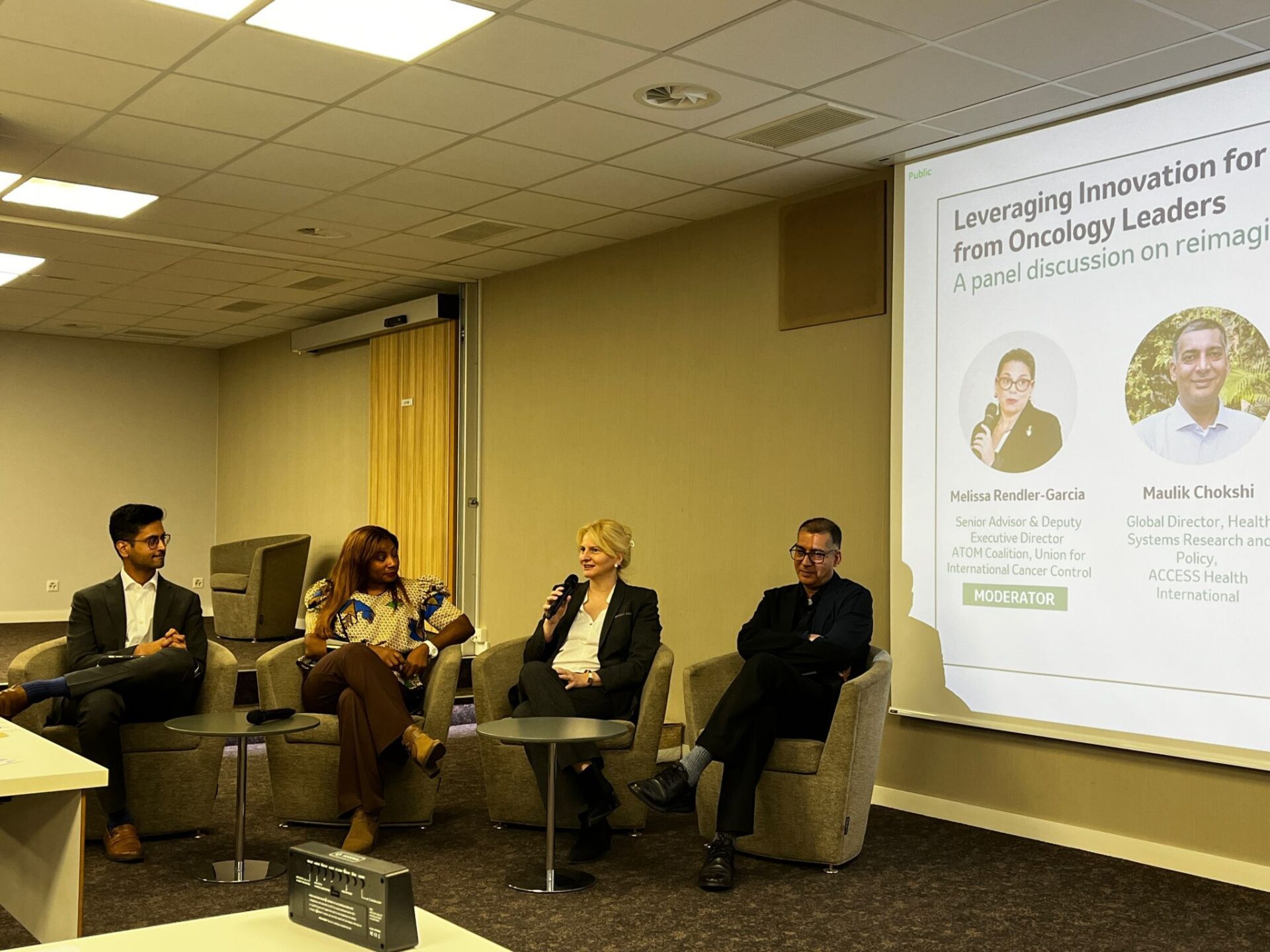
The most significant event for Mr. Chokshi during the WHA was his participation as a researcher grantee in a session on Driving Innovation in NCD Care with a Health Financing Lens. Hosted by MSD and organized by Panorama Global, this session brought together a diverse range of stakeholders from civil society, public health, academia, and the private sector. Discussions focused on leveraging innovation to improve access to quality care for noncommunicable diseases (NCDs) and the critical role of innovative healthcare financing in achieving long-term health system strengthening.
During the session, Mr. Chokshi shared the findings of his study, emphasizing that healthcare innovation must be viewed holistically. He highlighted the importance of integrating technology, financing models, process innovation, and enabling policies to create sustainable, scalable healthcare solutions. His insights reinforced the need for collaborative, cross-sector partnerships to address the growing NCD burden and improve care delivery worldwide.
ACCESS Health extends its gratitude to Alison Cox from the NCD Alliance, Mary-Ann Etiebet from Vital Strategies, and Anton Ussi from EATRIS for their contributions to meaningful discussions. Special thanks are also due to co-panelists Sophie Bussmann-Kemdjo from City Cancer Challenge, Mayank Anand from MedAccess, and Bosiljka Djikanovic Tetikovic from the University of Belgrade. We are also grateful to the hosts—Melissa Rendler-Garcia from the Union for International Cancer Control, Alexander Roediger from MSD, Julia Roper from Panorama Global, and Nikki C. from MSD—for facilitating such impactful dialogue.
As we move forward, ACCESS Health remains committed to advancing people-centered investments and fostering innovative, collaborative solutions to strengthen health systems and enhance NCD care globally.