
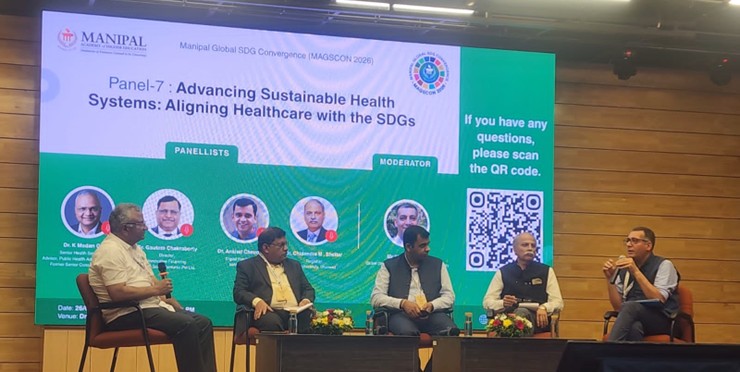
At the Manipal Global SDG Convergence (MAGSCON 2026), ACCESS Health International contributed to a critical dialogue on the future of sustainable healthcare systems, with Mr. Maulik Chokshi, Global Director – Health Systems Research and Policy at ACCESS Health International, moderating the session titled “Advancing Sustainable Health Systems Aligning Healthcare with the SDGs.” The session brought together diverse perspectives to explore how health systems can be reoriented to deliver long-term, equitable, and economically sustainable outcomes aligned with global development priorities.
The discussion was anchored in the recognition that health is not merely a social good but a foundational economic investment. A key theme that emerged was the urgent need to reduce out-of-pocket expenditure, which continues to push vulnerable populations into poverty. Ensuring access to affordable, high-quality medicines, both innovative and generic, was identified as a central lever in addressing this challenge. At the same time, participants emphasized the importance of moving beyond siloed financing approaches. A blended financing model, combining public funding, private sector participation, and philanthropic capital, was highlighted as essential to strengthening supply-side capacity and expanding access to care.
Digital transformation featured prominently in the conversation, particularly the role of the Ayushman Bharat Digital Mission in enabling interoperable health records. Such systems were discussed not only as tools for improving efficiency and governance but also as contributors to sustainability by reducing duplication of tests, minimizing paper use, and enabling continuity of care across providers. Broader applications of digital infrastructure, including track and trace systems, were also explored as mechanisms to support a more circular and accountable healthcare ecosystem.
The session also underscored the importance of shifting from reactive to preventive care models. Addressing social determinants of health, such as nutrition, ageing populations, and the rising burden of non-communicable diseases, was seen as critical to long-term sustainability. Particular attention was given to emerging challenges, including the loneliness epidemic among the elderly due to migration patterns, and the need for interventions that integrate health, social care, and community support systems. Preventive strategies, including road safety and school-level health education, were positioned as essential investments that can reduce future healthcare burdens.
Aligned with the United Nations Sustainable Development Goals, particularly SDG 1, SDG 3, and SDG 17, the session demonstrated how interconnected solutions across financing, technology, and community engagement can drive meaningful progress. The discussion emphasized that achieving sustainable health systems will require coordinated action across sectors, with partnerships serving as the backbone for scalable and inclusive solutions.
Overall, the session reflected a growing consensus that building sustainable health systems requires a holistic approach, one that integrates financial protection, digital innovation, and preventive care while placing individuals and communities at the center. As these ideas continue to evolve, ACCESS Health remains committed to advancing actionable pathways that translate such insights into resilient and equitable health systems.