
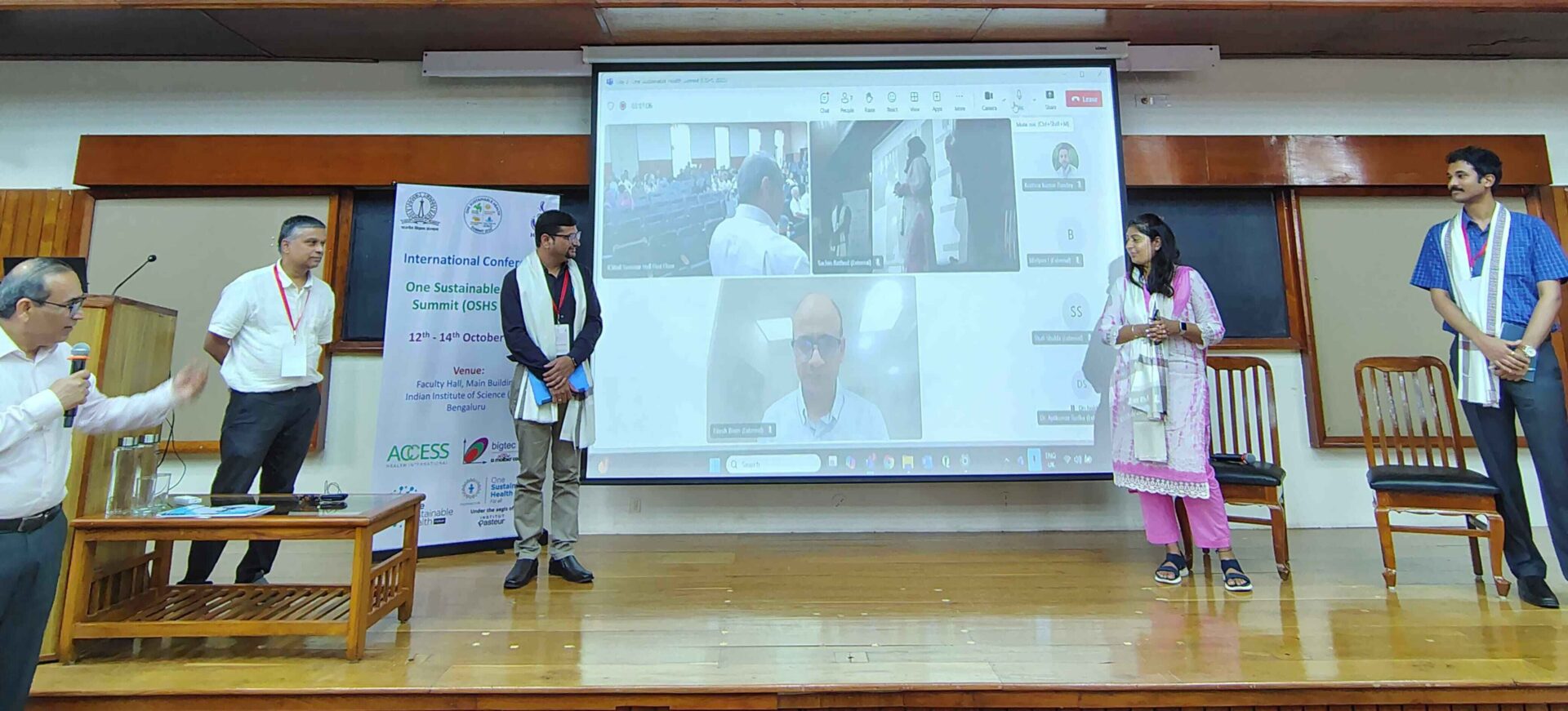
ACCESS Health International participated in the One Sustainable Health Summit organized by the Indian Institute of Science (IISc), Bengaluru, where it conducted a panel discussion on “Adaptive Transformation of Health Systems to the Concept of One Health”. The session served as a platform for experts to discuss how India’s health systems can evolve to embrace the integrated principles of One Health, linking human, animal, and environmental health.
The panel featured representation from leading national institutions and organizations working at the intersection of public health, environmental science, and policy. Dr. Anoop Velayudhan, Senior Scientist (Medical) at the Indian Council of Medical Research (ICMR), elaborated on the structures established at both central and state levels to operationalize the One Health concept. He also provided an overview of how the National One Health Mission is being activated and coordinated by ICMR to strengthen intersectoral collaboration and improve early detection and response mechanisms.
Dr. Rishi Bhagwati from One Health Trust shared his experiences in policy advocacy for One Health, highlighting the critical need for sustained coordination among diverse stakeholders to ensure effective implementation. He also emphasized the importance of vaccination in preventing antimicrobial resistance (AMR), noting that preventive interventions remain a cornerstone of the One Health approach.
Dr. Shivranjani Moharir, Senior Scientist from the Tata Institute for Genetics and Society (TIGS), presented her work on wastewater surveillance undertaken in partnership with the Office of the Principal Scientific Adviser (PSA) to the Government of India and the Bruhat Bengaluru Mahanagara Palike (BBMP) during and after the COVID-19 pandemic. She underscored how effective stakeholder coordination enhances interpretation of surveillance data and facilitates timely public health action, particularly in the early identification of emerging threats.
From the perspective of community engagement, Dr. Tikesh Bisen from PATH shared his experiences from a project on community-based surveillance in a district in Odisha. His work demonstrated the value of involving local communities as primary stakeholders, both as contributors and practitioners of the One Health approach. He shared positive findings from the field, illustrating how community participation not only strengthens surveillance but also supports sustained behavioral and environmental health improvements.
The session was moderated by Dr. Shrikant Kalaskar from ACCESS Health, who guided the discussion and shared the organization’s broader contributions to advancing the One Health agenda. He highlighted ACCESS Health’s ongoing work in promoting health literacy, strengthening engagement among tribal and indigenous communities, and fostering collaborative learning through the Global Learning Collaborative for Health Systems Resilience. Drawing from his experience working with indigenous populations, Dr. Kalaskar emphasized that these communities have long embodied the principles of One Health through their deep interdependence with nature and animals. He called for greater recognition of indigenous knowledge systems in shaping adaptive and inclusive health policies.
The discussion concluded with a consensus on three critical areas of focus for advancing One Health in India:
- Regular coordination among stakeholders: Sustained collaboration between public health, veterinary, and environmental sectors is vital for the success of the One Health approach.
- Interoperable data systems: Data generated across human, animal, and environmental health domains must be standardized, shared, and jointly interpreted to ensure timely and effective responses.
- Adaptive health systems: Health systems must be equipped to manage and integrate multisectoral data to coordinate surveillance, prevention, and response more effectively.
The panel reaffirmed that the One Health approach is not merely a policy framework but a practical, collaborative pathway toward building resilient and sustainable health systems. As ACCESS Health continues to promote multisectoral collaboration and evidence-based policymaking, this discussion stands as a reminder that health systems must evolve continuously: integrating knowledge, data, and community participation to safeguard both human and planetary health.