
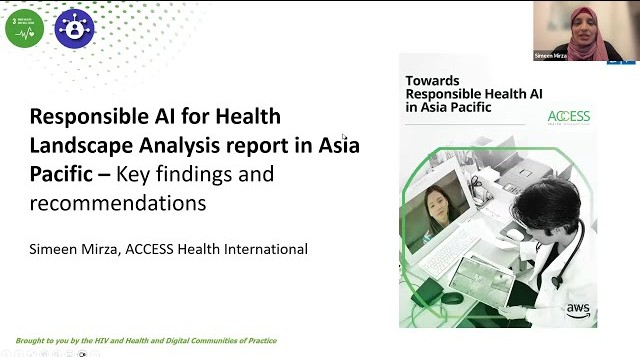
ACCESS Health International was invited to present its research findings at the UNDP webinar session titled “Presenting the Landscape Analysis – Towards Responsible Health AI in Asia Pacific” on October 7, 2025. Convened by the Digital Health for Development (DHFD) Hub, the session was organized through the HIV and Health Community of Practice and in collaboration with the Digital Community. It brought together 21 participants from five country offices, with more than 65 percent representing the UNDP Asia Pacific region.
The webinar highlighted key findings from ACCESS Health’s landscape analysis report, supported by Amazon Web Services, which examines the policy-to-practice landscape of responsible Health AI across 12 countries in the Asia Pacific region. The study provides a comparative analysis of national readiness, governance maturity, and regulatory frameworks, offering practical recommendations for strengthening Health AI ecosystems in the region.
Simeen Mirza from ACCESS Health International presented the findings of the report, outlining disparities in AI readiness between high-income countries such as Singapore, South Korea, Japan, and Australia, and middle-income nations like Indonesia and Viet Nam. She emphasized five key recommendations: establishing empowered oversight bodies, updating regulatory frameworks, promoting inter-country collaboration, ensuring agile governance, and addressing workforce mistrust through upskilling.
The session began with opening remarks by Kathryn Johnson, Regional Policy Specialist, Asia Pacific, UNDP, who underscored that AI in health should empower healthcare workers and patients, not replace them. She emphasized the importance of robust governance and inclusive, risk-based approaches to ensure equity, data integrity, and patient safety.
Country perspectives added depth to the discussion. Dr. Chris McBrearty, Health Governance Specialist, UNDP Viet Nam, shared Viet Nam’s progress in digital transformation and highlighted the government’s commitment to embedding transparency, accountability, and privacy in AI governance. Thomhert Suprapto Siadari, Ph.D., Member of the AI Committee at Indonesia’s Ministry of Health, showcased Indonesia’s SATUSEHAT platform and discussed the country’s innovative steps toward data integration, AI-driven diagnostics, and regulatory experimentation through sandboxes.
During the Q&A session, participants explored issues of interoperability, governance, and the ethical implications of AI. Simeen Mirza emphasized that responsible AI must prioritize clinical accuracy, ethical integrity, and societal benefits, citing the WHO and UNESCO frameworks as guiding examples.
Closing the session, Manish Pant, Digital Health Specialist, UNDP, called for continued collaboration and knowledge exchange to ensure AI technologies in health systems are safe, equitable, and trusted. He also shared that UNDP, together with ACCESS Health and WHO, plans to expand the landscape analysis to a global scale to strengthen responsible AI implementation worldwide.
ACCESS Health, together with partners, remains committed to advancing the dialogue on responsible and inclusive Health AI and to supporting evidence-based policymaking that strengthens digital health ecosystems across the Asia Pacific and beyond. For more information on UNDP’s Digital Health work, visit the Digital Health for Development Hub website.