
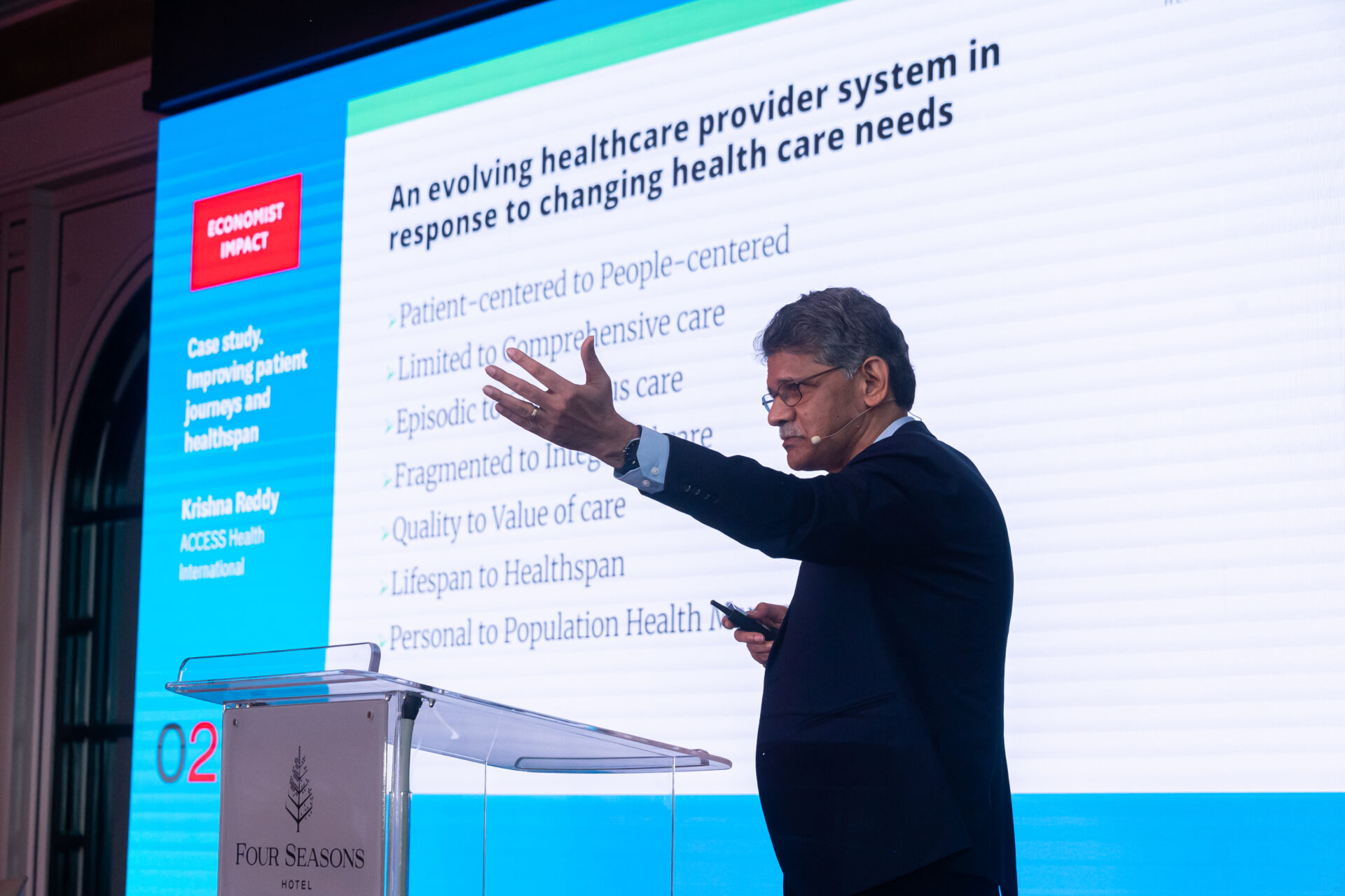
At the 5th edition of Future of Health Asia, organised by the Economist Impact, Dr. N. Krishna Reddy, CEO of ACCESS Health International, presented a case study titled “Improving Patient Journeys and Healthspan.” The session highlighted practical lessons for integrating artificial intelligence and systems thinking into health system design to improve long-term health outcomes.
Responsible AI and Governance
Dr. Reddy highlighted Taiwan as a global example of ethical AI governance. The Taiwan AI Center of Excellence (AICoE) integrates cross-ministerial resources and links industry, academia, and research sectors to establish the country as a leading hub for AI research and development. The Center for Responsible AI in Healthcare complements this by creating a governance framework grounded in ethical principles, ensuring that safety, accountability, and fairness evolve alongside technological progress.
Data Infrastructure
He emphasized that developing AI-based health innovations requires a strong healthcare data backbone. Reliable, secure, and interoperable data systems are critical for enabling AI-powered diagnostics, remote patient monitoring, and precision medicine. Scalable data infrastructure remains the foundation for sustainable and equitable digital health transformation.
Augmenting Clinicians
Drawing from expert perspectives shared during the session, Dr. Reddy noted that AI should serve as a decision-support system for clinicians – improving efficiency and accuracy while preserving the human touch. Rather than replacing clinicians, AI tools should enhance clinical decision-making and allow professionals to focus on empathy and patient-centered communication.
Continuous Patient Engagement
The discussion underscored that healthcare is no longer a one-time transaction. Patients increasingly expect continuous engagement across their care journey. Personalized communication and consistent support before, during, and after clinical interactions improve clinical outcomes and strengthen patient trust.
Systems Approach to Healthspan
Dr. Reddy reiterated that improving healthspan requires an iterative, system-wide approach that looks beyond healthcare delivery to address the broader determinants of health, including environmental, social, and behavioral factors. Building such an integrated system ensures that technology-driven innovation aligns with population health needs and supports long-term well-being.
Dr. Reddy’s insights guide ACCESS Health’s ongoing work on digital health, systems resilience, and responsible innovation. By promoting governance models, data readiness, and people-centered design, ACCESS Health continues to support the creation of health systems that are equitable, adaptive, and future-ready.